
Which is better, metal or plastic corner bead?
2025-04-23
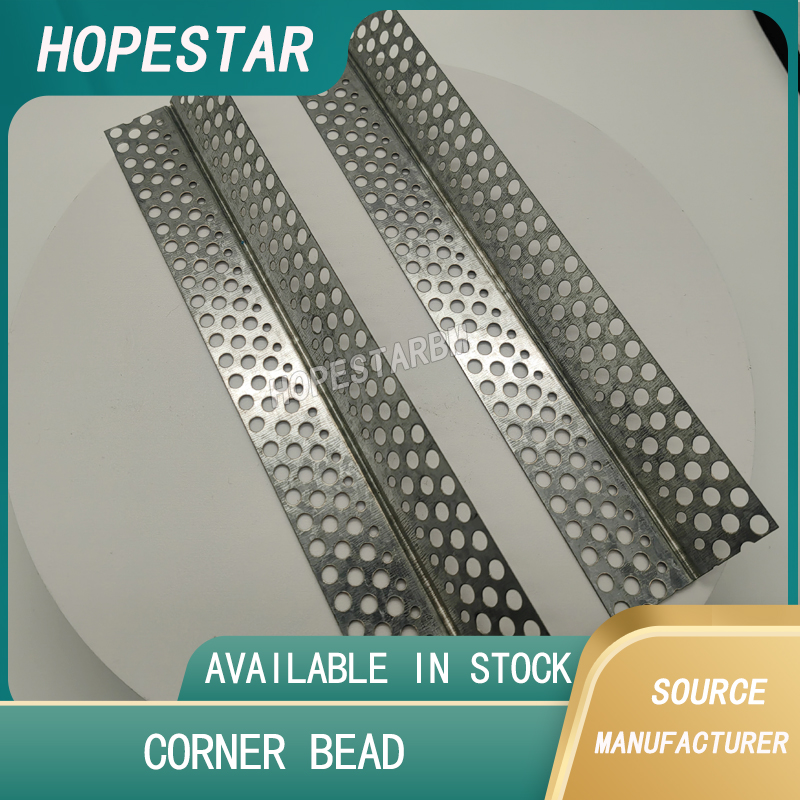
Which is better, metal or plastic corner bead?
1、 Metal Corner Bead
This is the most common traditional choice, usually made of galvanized steel.
advantage:
Very sturdy, with strong impact resistance, especially suitable for high flow areas such as corridors, schools, and hospitals.
After installation, the corner lines are straight and firm, making it easier to achieve professional grade corner effects.
It can be used for paper faced gypsum board and is also commonly used for the construction of paper faced gypsum board.
Disadvantages:
If the edge sealing is not done properly during construction or in a humid environment, it is easy to rust.
Relatively hard, not suitable for non-standard angles or curved edges.
Sawing or adjusting requires the use of tools, which are not as flexible as plastic.
2、 Plastic/PVC Corner Bead
Plastic corner protectors are mainly made of PVC (polyvinyl chloride) or other polymer materials, and have been increasingly used in residential and decoration in recent years.
advantage:
Moisture proof and rust proof, especially suitable for damp areas such as kitchens, bathrooms, basements, etc.
Has high flexibility and is suitable for curved walls or special shapes.
It is lighter to install and can be cut with scissors or art knives, making it more convenient for DIY or manual construction.
The surface usually has reinforced patterns, which make it easier to adhere putty and improve construction efficiency.
Disadvantages:
Compared to metal, it has slightly weaker impact resistance and may crack or deform after prolonged or strong impact.
If the quality is poor or there is a large temperature difference in the construction environment, problems such as thermal expansion, contraction, and detachment may occur.
Metal corner bead how to install
Why Use Drywall Corner Bead?
Related Article
Ceiling wall angle, also known as perimeter angle or L-angle, is an indispensable L-shaped metal profile for suspended drywall ceiling systems. Roll-formed from cold-rolled galvanized steel, ceiling wall angle is fixed along the wall perimeter to support the ends of main channels and furring channels,
Ceiling Wall Angle – Galvanized L-Shaped Perimeter Trim for Suspended Drywall Ceilings
Galvanized steel profiles are the foundational metal framing components widely used in modern interior construction. Roll-formed from cold-rolled steel coated with protective zinc layer, galvanized steel profiles cover a full range of shapes including C studs, U tracks, omega channels,
Galvanized Steel Profiles – Reliable Cold Rolled Framing for Drywall Walls and Ceilings

Metal furring channel for ceiling is a vital secondary framing component widely used in suspended ceiling and drywall ceiling systems. Roll-formed from cold-rolled galvanized steel, this lightweight metal profile works together with main channels, hangers and wall angles to create a level,
Metal Furring Channel for Ceiling – Galvanized Secondary Framing for Suspended Drywall Ceilings

Metal omega channel, also widely called omega furring channel or hat channel, is an indispensable secondary metal framing profile for modern suspended ceilings and drywall wall furring systems. Named after its distinctive Ω shape, this profile is roll-formed from cold-rolled galvanized steel
Metal Omega Channel – Galvanized Omega Furring Channel for Drywall Ceiling and Wall Framing